
ACM SIGGRAPH 2018 Award Winners Announced
ACM SIGGRAPH has announced their annual award winners including two inaugural awards for the ACM SIGGRAPH Practitioner and the ACM SIGGRAPH Academy. Award winners will be honored at the SIGGRAPH 2018 Opening Ceremony and Awards Presentation on Monday, August 13th at 9:00am at the Vancouver Convention Center (VCC) in West Building, Ballroom AB. The award winners, with the exception of the ACM SIGGRAPH Academy, will participate in the ACM SIGGRAPH Award Talks on Monday at 3:45pm in West Building, Room 211-214 at the VCC.
Daniel Cohen-Or was award The Computer Graphics Achievement Award for his seminal contributions in the field of geometry processing, shape analysis and image processing. The Computer Graphics Achievement award is given each year to recognize an individual for an outstanding achievement in computer graphics and interactive techniques.
Gordon Wetzstein was awarded The Significant New Researcher Award for his work in advanced display hardware and display-specific rendering techniques. The Significant New Researcher Award is awarded annually to a researcher who has made a recent, significant contribution to the field of computer graphics and is new to the field.
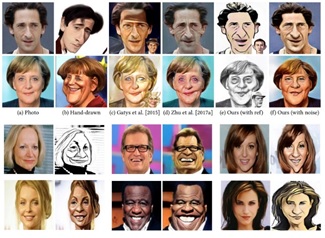
The award for The Outstanding Doctoral Dissertation Award went to Jun-Yan Zhu for his outstanding Ph.D. thesis on "Learning to Synthesize and Manipulate Natural Images." The award is annually given to recognize a recent doctoral candidate who has successfully defended and completed his/her Ph.D. dissertation in computer graphics and interactive techniques. This award recognizes young researchers who have already made a notable contribution very early during their doctoral study. The key criteria used to evaluate the nominations include technical depth, significance of the research contribution, potential impact on theory and practice, and quality of presentation.
The Outstanding Service Award, this year given to G. Scott Owen, is presented annually to recognize a career of outstanding service to ACM SIGGRAPH by a volunteer. It recognizes an individual who has given extraordinary service to ACM SIGGRAPH, both in the trenches and in positions of more responsibility or visibility, over a significant period of time. Scott has been honored for his long-term, visionary, and dedicated service to ACM SIGGRAPH.
Monika Fleischmann was awarded The Distinguished Artist Award for Lifetime Achievement in Digital Art for her pioneering efforts in the field of new media art through research projects based on interface design and new forms of communication. The Distinguished Artist Award is presented annually to an artist who has created a substantial and important body of work that significantly advances aesthetic content in the field of digital art.
In the inauguration of the ACM SIGGRAPH Practitioner Award, Bill Reeves has been named for his groundbreaking techniques in particle systems and Z-depth shadows, and in production software with the RenderMan renderer. The SIGGRAPH Practitioner Award recognizes outstanding contributions to the practice and advancement of Computer Graphics and Interactive Techniques.
The first class of the ACM SIGGRAPH Academy consists of past winners of The Steven Anson Coons Award, The Distinguished Artist Award for Lifetime Achievement in Digital Art, and The Computer Graphics Achievement Award. The ACM SIGGRAPH Academy is an honorary group of individuals who have made substantial contributions to the field of computer graphics and interactive techniques. These are principal leaders of the field, whose efforts have shaped the disciplines and/or industry, and led the research and/or innovation in computer graphics and interactive techniques.
ACM SIGGRAPH Academy
- Ivan E. Sutherland: For Sketchpad and for providing a vision for computer graphics that has sustained the field.
- Donald P. Greenberg: For pioneering original ideas, and for education of graduate students in computer graphics and computer-aided design.
- Andries van Dam: For unwavering pursuit of excellence in the field of computer graphics, and for contributions to computer graphics education and related fields.
- Ed Catmull: For outstanding creative contributions as an individual researcher, for inspirational leadership, organizational direction and mentorship
- José Luis Encarnação: For leadership in applied research, for work in establishing international graphics standards, and for contributions to computer graphics education.
- James Foley: For strong and sustained leadership in computer graphics education and research, and for dedication to the profession through books and his work with ACM/SIGGRAPH and ACM publications.
- James F. Blinn: For pioneering work in rendering and educational animation, and for exemplary contributions as an author.
- Pat Hanrahan: For leadership in rendering algorithms, graphics architectures and systems, and new visualization methods for computer graphics.
- Tomoyuki Nishita: For work in the rendering of natural phenomena that has inspired computer graphics researchers all over the world.
- Nelson Max: For pioneering work in scientific visualization, for deep technical contributions, and for generous encouragement and stimulation of ideas and intellectual exchange.
- Robert L. Cook: For numerous pioneering technical contributions to rendering, and for extraordinary service.
- James T. Kajiya: For numerous pioneering technical contributions to rendering, and computer graphics hardware design.
- Turner Whitted: For the invention of recursive ray tracing and for groundbreaking contributions to the areas of shaders, procedural graphics, graphics hardware, novel sensors, and sensor arrays.
- Henry Fuchs: For contributions to augmented and virtual reality, telepresence and graphics hardware, and for educating the leaders in the field of computer graphics.
- Jessica Hodgins: For foundational work in character animation, for support and cultivation of emerging researchers, and for extensive volunteer service to the computer graphics community.
- Lynn Hershman Leeson: For paradigm-changing innovations with a broad range of emergent applications, and pioneering new modes of storytelling, all accomplished with a strong aesthetic and insightful cultural discourse.
- Roman Verostko: For seminal contributions to the creation and promotion of digital art.
- Yoichiro Kawaguchi: For creative and innovative artistry, giving life to a stunning aesthetic derived from dedicated research in computer technology, biological forms, and contemporary artistic practice.
- Charles Csuri: For visionary work in the early recognition of the aesthetic potential of computer graphics, and for a lifetime of dedicated teaching and creative production.
- Jean-Pierre Hebert: For pioneering achievements in creating art through computer programming, and using algorithms and innovative techniques for new forms of creative expression.
- Manfred Mohr: For pioneering achievements in creating art through algorithmic geometry.
- Lillian Schwartz: For pioneering work using computers in art including graphics, film, video, animation, special effects, virtual reality and multimedia, and computer-aided analysis of art and architecture.
- Steina Vasulka: For pioneering work in video as a creative medium.
- Ernest A. Edmonds: For major contributions to the development of computational art, and to the broader field of contemporary art.
- Monika Fleischmann: For pioneering the field of new media art through research projects based on interface design and new forms of communication.
- James H. Clark: For the development of the "Geometry Engine."
- Loren Carpenter: For pioneering work in the design of algorithms for generating raster computer graphics, and for computer graphic images that mimic photographic realism.
- Alan H. Barr: For contributions to graphics, primarily for extending computer graphics shape modeling to include physically based and teleological modeling.
- John Warnock: For PostScript, which embodies a major contribution to imaging models, and to integration of graphics and text.
- Alvy Ray Smith: For seminal contributions to computer paint systems.
- Kurt Akeley: For contributions to the architecture, design, and realization of high performance 3D graphics hardware systems.
- Marc Levoy: For pioneering work in rendering volumes without an intermediate surface representation.
- Przemyslaw Prusinkiewicz: For work in the modeling and visualizing of biological structures.
- Michael F. Cohen: For the development of practical radiosity methods for realistic image synthesis.
- Tony DeRose: For seminal work in making subdivision surfaces a practical geometric modeling technique.
- David H. Salesin: For pioneering the field of non-photorealistic rendering in computer graphics.
- David Kirk: For bringing high performance computer graphics systems to the mass market.
- Peter Schrӧder: For pioneering work in geometry processing and multiresolution modeling.
- Hugues Hoppe: For pioneering work on surface reconstruction, progressive meshes, geometry texturing, and geometry images.
- Jos Stam: For pioneering work on subdivision surfaces, and on fast algorithms for the simulation of natural phenomena, especially fire, fluids, and gasses.
- Thomas W. Sederberg: For pioneering work on free-form deformations, and the use of algebraic geometry in geometry modeling.
- Greg Ward: For the development of the Radiance synthetic imaging system.
- Ken Perlin: For broad contributions to and impact on computer graphics, ranging from novel mathematical approaches for modeling to hardware interfaces.
- Michael Kass: For significant contributions to computer graphics, ranging from image processing to animation to modeling, and in particular for the introduction of optimization techniques as a fundamental tool in graphics.
- Richard Szeliski: For pioneering contributions at the intersection of computer graphics and computer vision, particularly in image-based modeling and rendering.
- Greg Turk: For contributions to physically-inspired mathematical application in graphics, particularly texture synthesis, geometric modeling, and physical simulation involving thin structures.
- Holly Rushmeier: For work on global illumination, material capture, and the display of high dynamic range images.
- Thomas Funkhouser: For work in 3D shape-based retrieval and analysis, and for work on interactive systems for both visual and acoustic modeling of complex virtual environments.
- Steve Marschner: For contributions to modeling the appearance of natural materials.
- Fredo Durand: For seminal contributions to the field of computational photography.
- Ramesh Raskar: For numerous, impactful research contributions to computational imaging and light transport.
- Daniel Cohen-Or: For seminal contributions to the fields of geometry processing, shape analysis and image processing.


Michael Bach is nationally and internationally recognized as a thought leader and subject matter expert in the fields of diversity, inclusion and employment equity, bringing a vast knowledge of leading practices in a live setting to his work. He has deep experience in strategy development, stakeholder engagement, training and development, research, solution development and execution, employee engagement, data analytics, measurement and diversity scorecards, targeted recruiting strategies, marketing and communications, Employee Resource Groups, Diversity Councils, and diversity related legislation (Employment Equity Act, AODA, etc.) among other skills and experiences related to field of diversity and inclusion.
Mashhuda Glencross career has spanned academia technical product management, independent consulting and working with start-ups. Her research focus is on creating effective virtual environments (VR/AR/XR) and has included 3D reconstruction, distributed VR, real time massive model rendering, visual perception, IoT, Visualisation and haptics. Her work has been published in high impact journals and conferences such as SIGGRAPH, TOG, TOCHI, IEEE TVCG, IEEE VR. She has also served on SIGGRAPH programme committees and reviewed for international conferences and journals. She is a current member of the ACM PACM steering committee and an associate editor for Computers and Graphics.
Kevin Griffin is a Group Leader for the Weapons Information & Infrastructure Integration Group at Lawrence Livermore National Laboratory in Livermore, California. Kevin is also a Software Engineer and Scientific Visualization Researcher for LLNL serving as one of the key developers for VisIt, a distributed, parallel visualization and graphical analysis tool for data defined on two- and three-dimensional meshes. He also serves as the technical lead for PyDV, a one-dimensional graphics and data analysis tool.
Dr. Aruquia Peixoto is an Assistant Professor at CEFET/RJ in Rio de Janeiro, Brazil. She have a B.S. in Mathematics from UFRJ (Federal University of Rio de Janeiro), a M.S. in Engineering of Computing and Systems from COPPE/UFRJ and a PhD in Mechanical Engineering from PUC/RJ, all these institutions are in Rio de Janeiro, Brazil, and are some of the best universities in Brazil. She worked in the implementation of the State University of Roraima in the extreme north of Brazil, in 2006. She advised undergraduate students in scientific projects in UERJ (State University of Rio de Janeiro), where she win four prizes as co-advisor, working with Paulo Rogerio Sabini, two prizes in UERJ, one as best work of Mathematics, and other as one of three best work in the technological field, and she have two honorable mention in a national student’s projects presentations in the Jornadas de Inicação Científica organized by IMPA (National Institute of Pure and Applied Mathematics). She is member of the ACM SIGGRAPH International Resources Committee since 2013, member of the SIGGRAPH Asia Symposium on Education Committee in 2016 and 2017, and co-organized the meetings Women in CG in SIGGRAPHand SIGGRAPH Asia Conferences, organized the meeting Girls in STEM in SIGGRAPH Asia in 2016 and 2017. During the year 2016 to 2017 she was visiting faculty at University of Kansas. In the conference IEEE EDUCON irganized and was the moderator of the roundtable Women in Engineering: Issues and Perspectives in 2017 and in 2018 was panelist of the round table Women in engineering: Addressing the gender gap, exploring trust and our unconscious bias and was the organizer and chair of the special session IDEE (Inclusion and Diversity in Engineering Education).
Artist and technologist Daniel Gene Pillis is a Research Assistant Professor in Immersive Environments at Virginia Tech’s Institute for Creativity, Arts and Technology. Their team pursues research at the intersection of queer theory, virtual reality, and embedded forms of consciousness in objects and narrative experiences. Diversity and technology, robotics archaeology, and methods for interacting with and understanding the phenomena of time, aging, and history are all current areas of research. Pillis was previously researcher and artist-in-residence at the Robotics Institute at Carnegie Mellon University with Dr. Christopher Atkeson, where they focused on soft machines and inflatable robotics. They hold a Masters degree focusing on Virtual Reality and Immersive Environments from Carnegie Mellon University, where they worked with the father of computer graphics, Ivan E. Sutherland, as well as esteemed computer scientist Jessica Hodgins. Previously, Pillis received a Bachelors in Cognitive Science from Rutgers University, where they conducted research in the Decision Making Laboratory with Dr. Gretchen Chapman. Pillis has exhibited work at the Warhol Museum, (Pittsburgh, PA) the Leslie Lohman Museum of Queer Art, (NYC), Newark Penn Station, (Newark, NJ) and has performed at the Museum of Contemporary Art, (Cleveland, OH), Open Engagement International Conference (Pittsburgh PA) and the Theatre for the New City in the East Village (NYC), as well as numerous other galleries and internet venues.
Hello, I am Natalie Rountree, and I graduated from Middle Tennessee State University in 2014 with a Bachelor's of Science with a focus in Digital Animation. After going to my first SIGGRAPH conference in 2014 as a student volunteer, I was hooked as soon as I picked up my SV T-shirt. I applied the next year as a Team Leader and got an amazing opportunity to grow within the conference community. I continued that role for the next 2 years after, in the mean time talking about a possible focus area to highlight adaptive technology within the conference. One of my dreams came true and I am honored I get to Co-chair the Adaptive Technology Focus Area at SIGGRAPH 2019.
Caroline Simard is passionate about building better workplaces for women through evidence-based solutions. As Managing Director of the Stanford VMware Women's Leadership Innovation Lab, she is responsible for the execution of the research agenda, business operations, and people management. She also leads the Lab's Corporate Affiliates program. Previously, she was Senior Director of Research.